


Oil Condition Monitoring: Method, Interpretation and Industrial Application · Global Voices

Oil Condition Monitoring in Industrial Practics
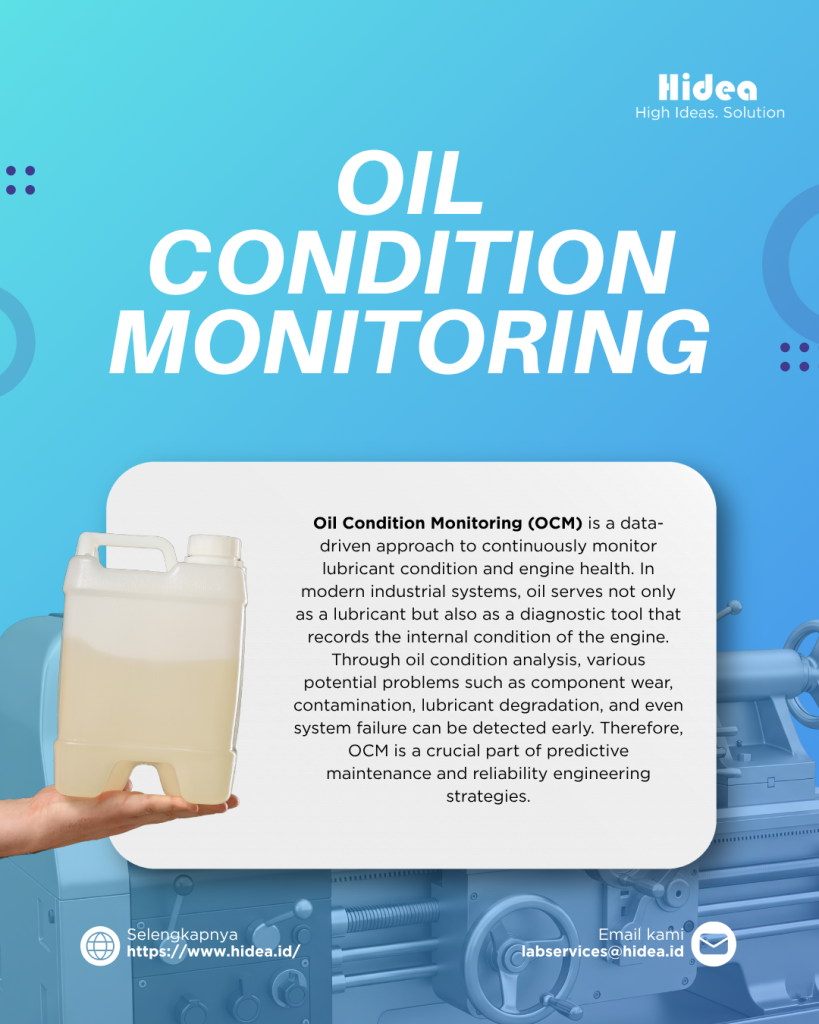
Oil Condition Monitoring (OCM) It's a data-based approach to monitoring the lubrication and health conditions of machines continuously. In modern industrial systems, oil not only acts as lubricant, but also as diagnostic media It recorded internal engine conditions.
Through the analysis of the condition of the oil, potential problems such as component wear, contamination, lubrication degradation, up to system failure. can be detected earlier. Therefore, the OCM is an important part of strategy predictive maintenance and reliability engineering.
This approach not only helps prevent damage, but also provides a strong basis for operational decision-making and business.
Main Parameters in Oil Condition Monitoring
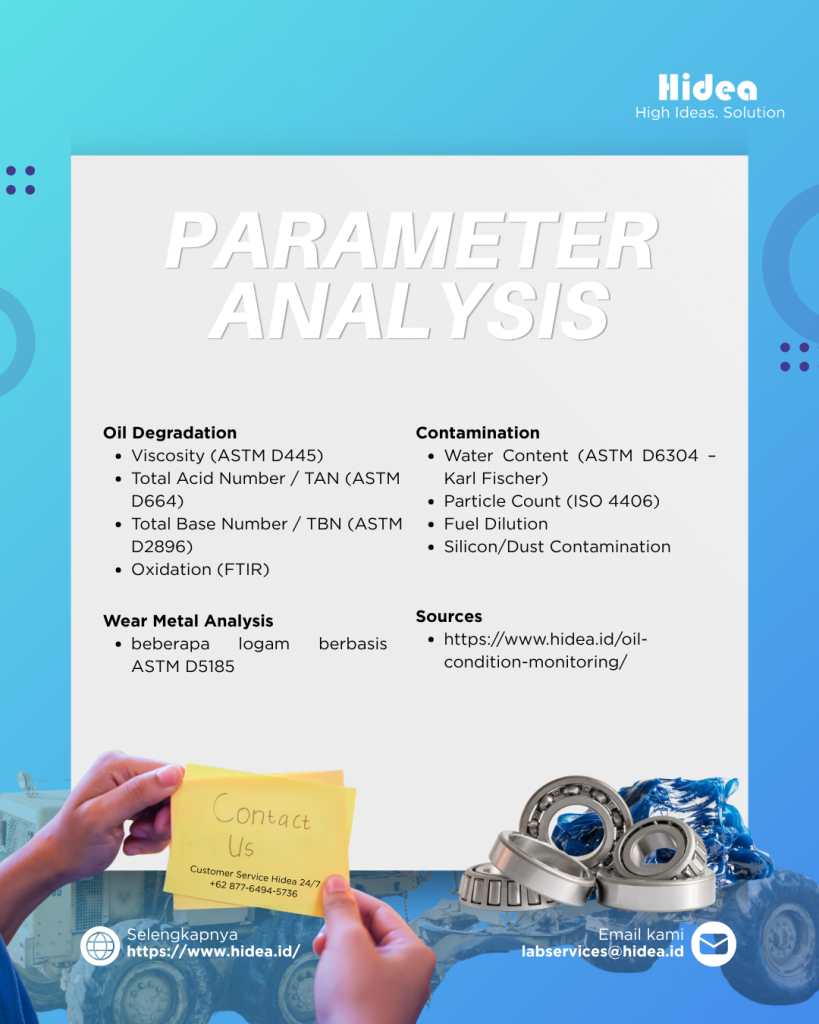
The success of the OCM depends heavily on analysed parameters. In general, those parameters can be grouped into three major categories: Oil conditions, contamination and engine wear..
1. Lubrication Condition (Oil Degradation)
This parameter shows whether the oil is still viable or is already degraded.
- Viscosity (ASTM D445)
The viscosity changes show oxidation, contamination, or any other fluid mixing. - Total Acid Number / TAN (ASTM D664)
Indications of increased acid due to oxidation. - Total Base Number / TBN (ASTM D2896)
Used on an oil engine to measure acid neutralization skills. - Oxygen (FTER)
Identifying oil chemical degradation.
2. Contamination
Contamination is one of the main causes of oil performance and engine damage.
- Water Content (ASTM D6304 - Karl Fischer)
Water can cause corrosion and dehydration. - Count Particle (ISO 4406)
Shows oil hygiene levels. - Fuel Dilution
General on engine, it can lower viscosity. - Silicon / Dust Contamination
Indications of entry dust from the environment.
3. Metal wear Analysis
Using techniques like ICP (ASTM D5185), this parameter shows the wear of the engine component.
Example:
- Fe
- Cu (copper)
- Al (aluminum)
Testing Method in Oil Condition Monitoring
OCM involves various methods of complete analysis.
1. ICP (Inducious Coupled Plasma)
Used to detect wear metal and contaminant metal in the ppm.
Over:
- Accurate and sensitive
- Able to analyze many elements at once
2. FTER (Fourier Transform Infrared)
Used to detect:
- Oxygen
- Nitration
- Chemical contamination
Over:
- Hurry up
- Doesn't require complex preparation
3. Karl Fischer (Water Content)
The most accurate method of measuring water levels.
Over:
- High sensitivity (ppm level)
- Industrial standards
Four. Particle Counter
Is used to determine Oil hygiene levels According to ISO 4406.
5. Viscosity Measurement
Basic parameters to ensure lubricant performance remains according to specs.
Interpretation Data Oil Condition Monitoring
One of the biggest mistakes in OCM is just looking at numbers without understanding its meaning. Interpretation of data is the core of the OCM.
1. Trend Analysis vs Single Data
Single data is often not enough. What's more important is:
- Did the grades increase?
- How quickly did change happen?
Example:
- Fe is slowly increasing
- Fe increases drastically
2. Cross Parameters Correlation
Interpretation must be done by multi-parameter.
Example:
- Viscosity down + fuel dilation high contamination fuel
- High water + particle count rising potential damage seriously
3. Baseline and Limit Alarm
Each machine has a different baseline. Therefore:
- Use historical data
- Specify threshold (warning & critical)
Four. Failed Mode Identification
OCM can be used to identify any type of damage:
- Abrasive wear
- Adhesive wear metallic contact directly
- Corrosive wear because of water or acid
Online vs Offline Oil Condition Monitoring
OCM can be carried through two main approaches:
Offline Monitoring (Laboratory Analysis)
Character:
- Periodic sampling
- Full analysis and accurate
Over:
- High detail
- Many parameters
Lack:
- No reality-time
- Depending on the sampling schedule
Online Monitoring (Real- Time Sensors)
Character:
- Sensors directly installed on the system
- Real-time data
General parameters:
- Particle count
- Moisture
- Dielectric constant
Over:
- Quick detect
- Matches for critical equipments
Lack:
- Unlimited parameters
- Higher investments
Best Combination
The best practice is to combine:
- Online monitoring Quick detection
- Offline analysis Inner analysis
Oil Condition Monitoring Applications in Various Industries
1. Turbine (Power Plant)
- Monitoring oxidation and varnish
- Important to prevent downtime
2. Gearbox Industries
- Focus on wear metal and container
- Prevent gear failure
3. Hydraulic System
- Focus on cleaning (ISO 4406)
- Sensitive to particles
Four. Engine and Heavy Equiment
- TBN monitoring, soot, fuel lusion
- Specify oil replacement interval
Business Impact Oil Condition Monitoring
OCM is not only technical, but it also affects business directly:
1. Downtime Reduce
Early detection prevents large failures
2. Save Madness Cost
Maintenance is done when necessary, not based on a fixed schedule
3. Extend Asset Age
Machines are more lasting due to controlled conditions
Four. Increase Operation Efficiency
The performance machine remains optimal
General Error in Oil Condition Monitoring
- Sampling is not representative
- Do not trend analysis
- Ignoring specific parameters
- Wrong data interpretation
- Do not use standard method
Conclusion
Oil Condition Monitor It's an important tool in the modern industry to ensure engine power and operational efficiency. By understanding parameter, method analysis, and data interpretation, companies can turn lab data into high-value insight.
The exact approach in OCM allows industry to:
- Reduce the risk of failure
- Optimize the cost
- Increase productivity
Thus, OCM is not only a monitoring tool, but is part of the strategy sustainable asset management.
Oil Analysis Service Information
For needs Oil Condition Monitoring and industrial standard-based lubricant analysis, please contact:
Customer Service PT. Hidea Inti Daya
📞 +62 877-6494-5736
