


Gravity API, Density, Pour Point, and Viscosity: Four Important Parameters in Crude Oil and Diesel Fuel Analysis · Global Voices
Hidea Accreditation Certificate
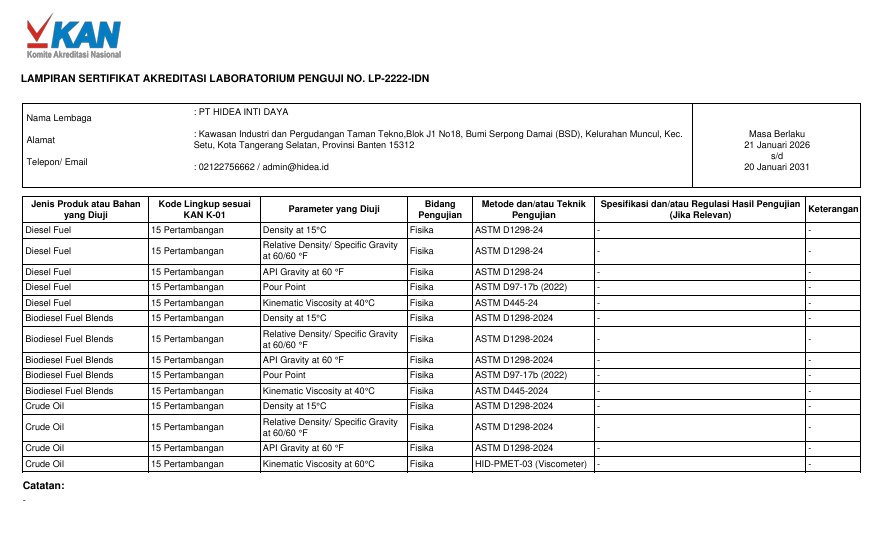
In the oil & gas industry, the quality of a product is not only defined by the origin of its materials, but also by its physical characteristics and performance during storage, transportation, or processing. Therefore, lab testing becomes an important part of ensuring that the oil crudes, diesel fuel, or biodiesel meet the technical specifications required.
Among the various parameters used in the characterization of the petroleum product, there are four parameters that are almost always the primary concern, which is Density, Gravity API, Pour Point, and Kinematic Vistolity. These parameters are also part of an accredited lab testing scope for various petroleum matrices such as crude oil, diesel fuel, and biodiesel blends.
More than just numbers in the lab report, these four parameters test results were used to support operational decisions, quality control, custom transfers, to the optimization of processes in the migas industry.
Why is the physical characterization of Petroleum so important?
Each oil crude has a different characteristic. Similarly diesel fuel produced by refinery or used in distribution systems.
The different characteristics can affect:
- The value of the product economy
- Slowly transport
- Processing efficiency
- Machine and equipment performance
- The matching to customer specifications
Therefore, measurement of physical parameters must be used using validated methods and competent labs. ISO / IEC standards 17025 emphasis that the lab should be able to generate valid, consistent, tracable data. Lab activation by IT became formal evidence that the competence had been evaluated and recognized.
Density: Basic Mass and Volume calculations · Global Voices
Is that Density?
Density is the mass of a substance per unit of volume at a certain temperature. In the petroleum industry, density is usually reported at certain standard conditions, for example. 15 ° C.
These parameters are often considered simple, but have a very large role in industrial operations.
Why is Density important?
1. Custody Transfer Count
Transaction of oil crudes and petroleum products is generally done by volume or mass.
Because the volume of the fluid is changed by temperature, the density is used to correct and convert so the calculation becomes more accurate.
2. Inventory Management
Petroleum storage tanks can contain thousands to millions of liters of product.
Density data used for:
- Stock count
- mass seraca
- Inventory Reconciliation
3. Quality Control
Unnormal density changes may indicate:
- Contamination
- Blending error
- Change product quality
Density Testing Method
One of the many methods in the petroleum industry is:
ASTM D1298
This method uses hydrometers to determine density, relative density, and the Gravity API on liquid petroleum products.
Gravity API: Universal Language Oil Industries · Global Voices
What is API Gravity?
The Gravity API is a parameter developed by the American Petroleum Institute to describe the level of "light" or "heavy" of an oil compared to water.
The higher the grapevity API value, the less the oil tends to go.
Instead, the low gravity API shows a heavier oil.
General Crude Oil Classification By API Gravity
| Category | Gravity API |
|---|---|
| Light Crude | > 31 ° API |
| Medium Crude | 22-31 ° API |
| Heavy Crude | < 22 ° API |
Why is API Gravity important?
Set Crude Oil Economic Value
Crude oil with high-gravity API generally produces more fraction of the light products, like:
- LPG
- Naphtha
- Gasoline
Therefore, light oil crudes often have higher economic value than heavy oil crudes.
Basic Kerang Process Selection
Oil refinery uses API Gravity as one of the initial parameters for:
- Specify processing strategy
- Estimating product yield
- Optimize distillation operations
Help Product Quality Evaluation
The Gravity API is often used with sulfur content and density to give a general picture of the quality of the oil crude.
Relative Density (Specific Gravity): Bridge between Density and API Gravity
Relative Density or Specific Gravity shows the comparison between density of a product against water density on certain reference conditions.
This parameter is important because:
- Used in various industrial calculations
- It's the basis of API Gravity
- Decrease comparison between petroleum products
In many laboratory reports, Density, Specific Gravity, and API Gravity reported simultaneously because all three are related.
Pour Point: Determines Rate capabilities at Low Temperature · Global Voices
What's Pour Point?
Pour Point is the lowest temperature when a petroleum product can still flow in certain testing conditions.
This parameter is very important especially at:
- Crude oil
- Diesel fuel
- Biodiesel blends
Why is Pour Point important?
1. Product Storage
If the temperature of the environment drops close or below the pour point value, then the product can have difficulty flowing.
This potentially causes:
- Pipeline clogging
- Compressions difficulty
- Distribution
2. Transport
In low-range areas or offshore processes, the characteristics of the flow become critical factors.
Product with high pour points may require:
- Warm
- Insulation
- Tracking system
3. Field Operations
On some paraponic oil crudes, the formation of wax can increase the risk of operational interference.
The pour point test helps the operator understand fluid behavior in actual condition.
Pour Point Testing Method
The pour point testing is generally done using:
ASTM D97
This method becomes one of the most common standards in the petroleum industry to determine the characteristics of the path at low temperatures.
Cinematic Vistoity: Main Performa Fluida Parameters
What is the Kinematic Vistoity?
The Cinematic Vistoity shows a fluid barrier to the flow due to gravitational force.
Simply put, the viscosity describes how thin a liquid can be.
Why is Visciousness so important?
1. Transport System
Viscosity impacted:
- Pump capacity
- Pape pressure
- Energy consumption
The higher the viscosity, the more energy it takes to move the fluid.
2. Operation Lang
viscosity characteristic affects:
- Heat transfer
- Mixing
- Synchronization
3. Product Perfortions
In diesel fuel and biodiesel blends, the viscoity too high or too low can affect:
- Fuel atoms
- Burning efficiency
- Injection system performance
Viscosity Testing Method
One of the most common methods used is:
ASTM D445
This method determines the kinetic vision at certain temperatures using capillary viscomers.
Parameter Relationship
Although it's often reported separately, these four parameters are actually related.
| Parameter | Main Function |
|---|---|
| Density | Set the mass and volume |
| Gravity API | Oil crude classification |
| Pour Point | Low temperature flow characteristic |
| Viscosity | Ability flowing and pumped |
For example:
- Crude oil with low gravity API usually has higher density.
- High-viscosity products often have bigger transportation challenges.
- High pour points can increase the risk of flow disorder at low temperature.
Therefore, laboratory interpretation should be done thoroughly, not based on one parameter.
Why should Testing be performed by Accredited Laboratory?
Many companies just look at the end results without considering how the data was produced.
Whereas, in the migas industry, the quality of decision depends on the quality of data.
ISO / IEC 17025 sets the terms of laboratory competence to make the test results valid, consistent, and trustworthy. Lab activation is also of course Scope-specific, which means laboratory competence is recognized only for parameters and methods listed in the scope of accredities.
For lab service users, it's important because:
- Reduce risk of data error
- Support contract compliance
- Ensure the test results
- Gives a higher belief in technical and commercial decisions
ISO / IEC 17025 internationally recognized as the standard competency lab testing and calibration that ensures the results of valid measurement and widely accepted.
Conclusion
Density, API Gravity, Pour Point, and Cinematic Viscosity are four major parameters in the character crude oil, diesel fuel, and biodiesel blends. Each one provides important information about the quality of products, the ease of transportation, the behavior of flow, as well as the value of economies.
In industrial practice, the test results are used to support quality control, custom transfer, inventory management, until operation optimizations. Therefore, testing should be done using the appropriate standard method and by a laboratory that has competence that can be proven through ISO / IEC-based ISO / IEC 17025 accreditation.
Testing Service Information
PT Hidea Core provides testing services for various petroleum matrices, including:
- Density at 15 ° C
- Relative Density / Specific Gravity at 60 / 60 ° F
- API Gravity at 60 ° F
- Pour Point
- Kinematic Vistolity
- Crude Oil
- Diesel Fuel
- Biodiesel Fuel Blends
For technical consulting and testing requirements:
Customer Service PT. Hidea Inti Daya
📞 +62 877-6494-5736