


Compressed Air Analysis Based on ISO 8573: Test Parameters, Methods Lab, and Results Interpretation · Global Voices
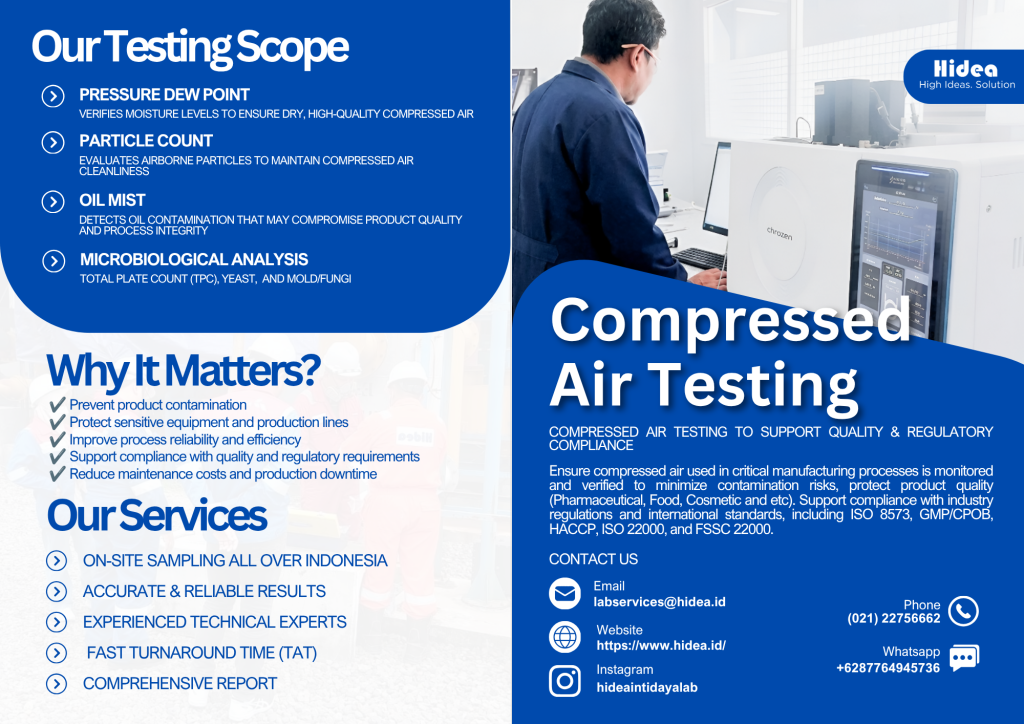
Why does Compressed Water need testing?
Compressed water is often referred to as "fourth utility" After electricity, water, and gas. In many industries, pressurized air is being used directly in the production process, from moving a pneumatic instrument to a direct contact with products in the food industry, pharmaceutical, electronics, and oil & gas.
Although it looks clean, compressed water can actually bring in various contaminants that come from the atmosphere, the compressor system, the pipeline, or lubricant compressor. The contaminant can lower the quality of the product, cause equipment damage, increase the maintenance costs, resulting in a discrepancy of regulatory requirements.
Therefore, the quality testing compressed water periodically becomes an important part of the quality insurance system. The most widely used international standard as reference is ISO 8573, which regulates pressurized air quality classification as well as testing methods.
What is ISO 8573?
ISO 8573 is an international setting standard water compressed quality based on the type and number of contaminants allowed.
These standards consist of some complementary parts.
| ISO 8573 Section | Scope |
|---|---|
| ISO 8573-1 | Compressed water quality classification |
| ISO 8573-2 | Aerosol oil measuring method |
| ISO 8573-3 | Humidity Measure |
| ISO 8573-4 | Solid particle measurement |
| ISO 8573-5 | Vapor oil measure |
| ISO 8573-6 | Gas contaminant |
| ISO 8573-7 | Microorganisms |
| ISO 8 | Particle concentration by mass |
| ISO 8573-9 | Liquid water content (liquor water) |
In laboratory practice, ISO 8573-1 became the reference to determining water compressed quality class, while other parts explain the sample method and test each parameter.
Main Contaminan in Compressed Air
In general, the compressed water quality is determined by three major contaminant groups.
1. Firm Particle
Particles can come from:
- Atmospheric dust
- Corrosion on the pipe
- Metal splinters
- Karat
- Malformed filter material
Very small particles can cause:
- Pneumatic instrument malfunction
- Nozzle blockage
- Decrease product quality
- Contamination of manufacturing process
2. Water (Moisture)
Atmospheric air always contains water vapor. Once compressed, the concentration of water vapor increases so potentially form condensate.
Moisture can cause:
- Pape corrosion
- Microorganism growth
- Porumatic valve malfunction
- System efficiency drop
The usual parameters are:
- Pressure Dew Point
- Relative Humidity
- Liquid Water
3. Oil
Oil contamination can come from:
- Lubricated compressor
- Unoptimal Oil separator
- System lubrication
This contaminant contamination became:
Aerosol Oil
The liquid particles of oil are carried by air flow.
Oil Vapor
Oil in the form of steam is invisible visually.
These two parameters must be analyzed separately because they use different testing methods.
Testing Parameters in ISO 8573 Testing
The water compressed labs generally do some of the following tests.
Particle Count
This parameter determines the number of particles at a given size.
Sample size:
- 0.1 p.m.
- 0.5 p.m.
- 1x03
- 5m
Results used to determine ISO Class as ISO 8573-1.
Aerosol Oil
Aerosol oil is analyzed using special media filters that capture oil particles during the sampling process.
This parameter is important to:
- The pharmaceutical industry.
- Food & Beverage
- Electronic
- Air Instrument
Oil Vapor
Contrary to aerosol, oil vapor requires an adsorben media to capture the hydrocarbons compound in the gas phase.
Lab analysis determines the concentration of oil vapors in mg / m units.
Pressure Dew Point
Pressure Dew Point (PDP) shows temperatures when water vapor starts to condense at certain pressures.
The lower the GDP value, the drier the water compressed.
For example:
- PDP -20 ° C
- PDP -40 ° C
- PDP -70 ° C special application
Microbiological Test
For the pharmaceutical industry, food, water, and health facilities, compressed water that comes directly to contact with products also needs to be tested against:
- Count's total
- Yeast & Mold
- Coliform
- Another microorganism.
Compressed Air Peak on Laboratory
The water-compressed testing didn't begin with lab analysis, but from the proper sampling process.
Stage 1 — Sampling Point Detention
The sampling location should represent the air quality that was actually used in the production process.
Several common locations selected:
- After the water dryer
- After the end filter
- Before the use point (point of use)
Phase 2 — Sample Fetch
Sample Technique should pay attention:
- Flow rate
- System pressure
- Samling Length
- Cleanliness fitting and hoses
An error at this stage can produce unrepresentational data.
Stage 3 — Lab Analysis
Once the samples are received, the lab does an analysis of the parameters requested using a relevant method based on ISO 8573.
Stage 4 — Data Validation
Data analyzed to ensure:
- No anomalies.
- Result meets quality control
- Testing meets method requirements
Stage 5 — Results Reporting
Test results report generally contain:
- Test parameters
- Results
- Units
- ISO Class (if true)
- Test method
ISO 8573 Results Reading Way
For example the test results show:
| Parameter | Results |
|---|---|
| Particle | ISO Class 2 |
| Oil | 0.004 mg / m |
| Pressure Dew Point | -40 ° C |
The interpretation is:
- Particle content meets ISO Class 2 boundaries.
- The oil content is very low and suitable for many industrial applications.
- Air has a good degree of drought so the risk of condensation can be minimized.
The result interpretation should consider the specific process and industrial requirements in effect, not just compare numbers to maximum limits.
General Error While Sampling Compressed Air
The accuracy of the test results is greatly influenced by the quality of the sample process. Some mistakes are common among others:
- Sample points don't represent actual conditions.
- A hose or a contaminated sampling fitting.
- The sampling path rate doesn't fit the method.
- Sampling done before the system reaches stable operating state.
- The sampling time is too short so the results are unrepresentational.
That error may cause the test results to deviate from the actual conditions and affect operational decisions.
ISO 8573 application in Various Industries
Food & Beverage
Compressed water is often in direct contact with products or packaging so that air quality should be controlled to prevent contamination.
Pharmaceutical Industries
pressurized air is used in the process of production, refueling, and loading of drugs. The control of particles, oil, water and microorganisms becomes very important to meet GMP requirements.
Electronic Industries
Particles and motives can damage sensitive electronic components. Therefore, compressed water with a high cleaning class is required in manufacturing.
Oil & Gas
Compressed water used as water instructionPneumatic actuators, control systems, to the utility of the process. Air containing water or oil can cause corrosion, instrument interference, and lower systems reliability.
It's an accredited Laboratory.
Testing compressed water should be done by the lab implementing SNI ISO / IEC 17025 Because this standard ensures technical competence, method validation, measurement, and test control. Thus, the generated data is more trustworthy as the basis of compressing water quality evaluations and fulfilling customer requirements as well as regulator.
Conclusion
The testing compressed water based on ISO 8573 is not only intended to know whether the air is pressurized "clean," but ensuring that the air quality is consistent with the process's needs and not causing risk to products or equipment.
Through testing parameters like particles, oil aerosol, oil vapor, pressure dew point, and microbiology, companies can identify the potential contamination early on, improve the system's reliability, and support industrial standards.
The presentation of a representative sample, the proper test method, and the proper interpretation of the results is three key factors to acquire accurate data and can be the basis for decision making.
Compressed Air Testing Service Information
PT Hidea Core provides service Compressed Air Analysis In industrial need, covering sample retrieval and pressure quality parameters to support ISO 8573 standards.
For technical consulting and service information, please contact:
Customer Service PT. Hidea Inti Daya
📞 +62 877-6494-5736